
A crochet lace runner is a length of open, breathable crochet work that transforms any surface it touches into something quietly extraordinary. It carries the feeling of late summer afternoons, linen tablecloths, and the particular pleasure of making something both useful and beautiful.

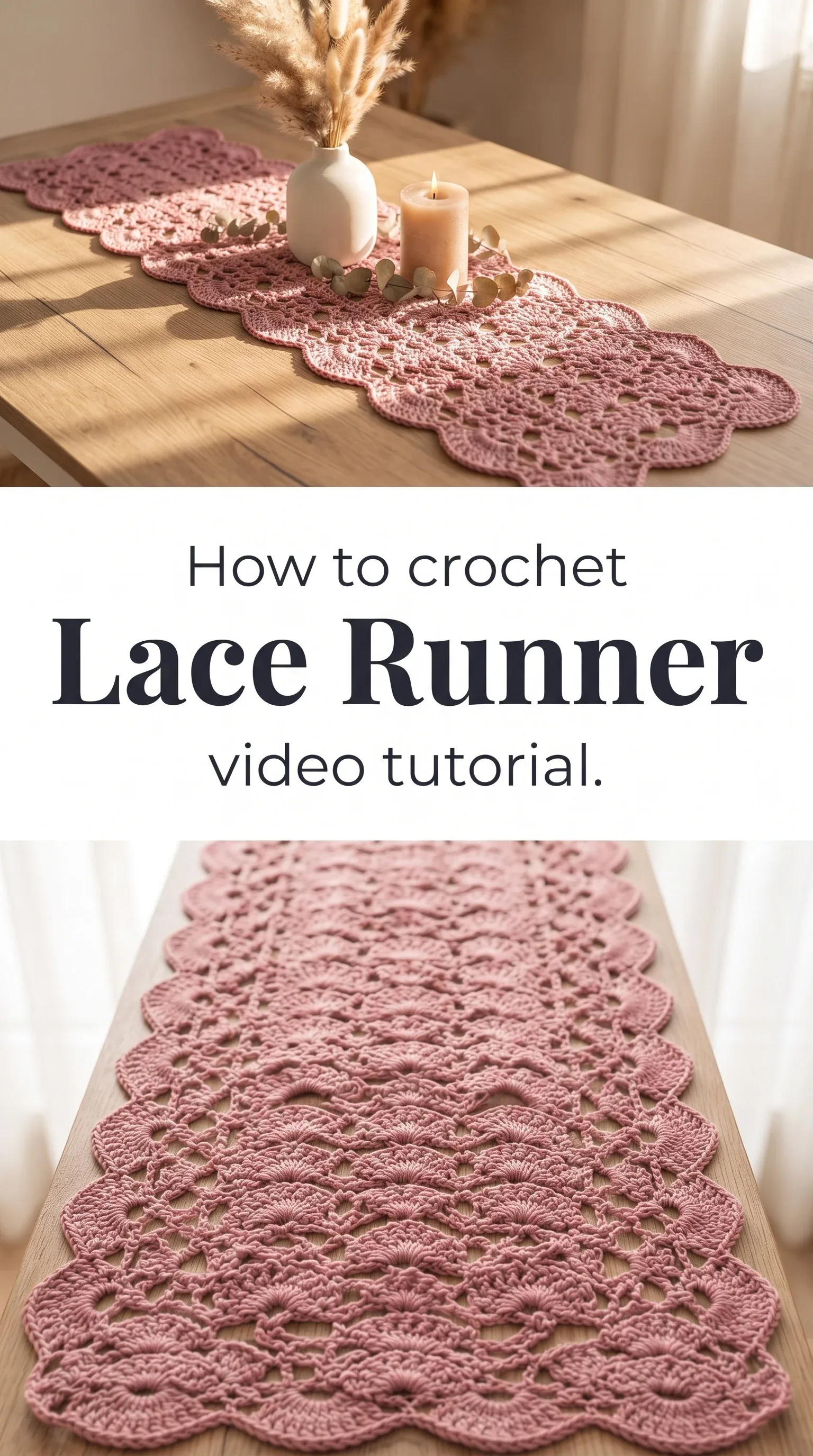
The Lace Runner
This crochet lace runner is the kind of piece that makes a dining table feel curated without being fussy, the kind of thing guests notice before they can explain why. The pattern is built from repeating fan-shaped motifs that create a rhythmic wave of open mesh and clustered DCs, giving the finished piece an airy yet structured quality that drapes softly without losing its shape. It suits anyone who loves handmade home decor, whether you are newly addicted to the hook or someone who crochets through long evenings with a cup of something warm beside you. The lace runner sits beautifully flat, with scalloped edges that feel generous and finished rather than fiddly.
Lace Runner Related Posts:
- Crochet Rose Bouquet: A Romantic Floral Masterpiece
- Crochet Jasmine Stitch Basket: A Delicate Storage Solution
- Crochet Lace Stitch: A Stunning Dimensional Pattern
- Crochet Leaf Dishcloth: A Fresh and Eco-Friendly Essential
In dusty rose or mauve, as shown in the reference images, this crochet lace runner has an antique softness that works across modern farmhouse, cottagecore, and Scandinavian-inspired interiors. You could also work it in natural ecru, deep sage, or washed linen for a completely different mood. Lay it across a console table, a sideboard, a coffee table, or even a bedroom dresser and it instantly reads as intentional and handcrafted in the best possible way.
Materials and Tools
To recreate this crochet lace runner, you will want a sport weight or DK weight yarn in a smooth, tightly twisted fiber that lets the lace structure breathe and show clearly. Cotton or a cotton-linen blend is ideal here because both have the subtle stiffness needed to hold the fan motifs open after blocking, and they wash beautifully over time. A 3.5mm or 4mm crochet hook works well depending on your gauge and tension, with a 4mm being slightly more forgiving for those who crochet tightly. Keep a yarn needle close by for weaving in ends cleanly along the scalloped edges, and a set of rust-proof blocking pins will make a visible difference once you finish the piece.
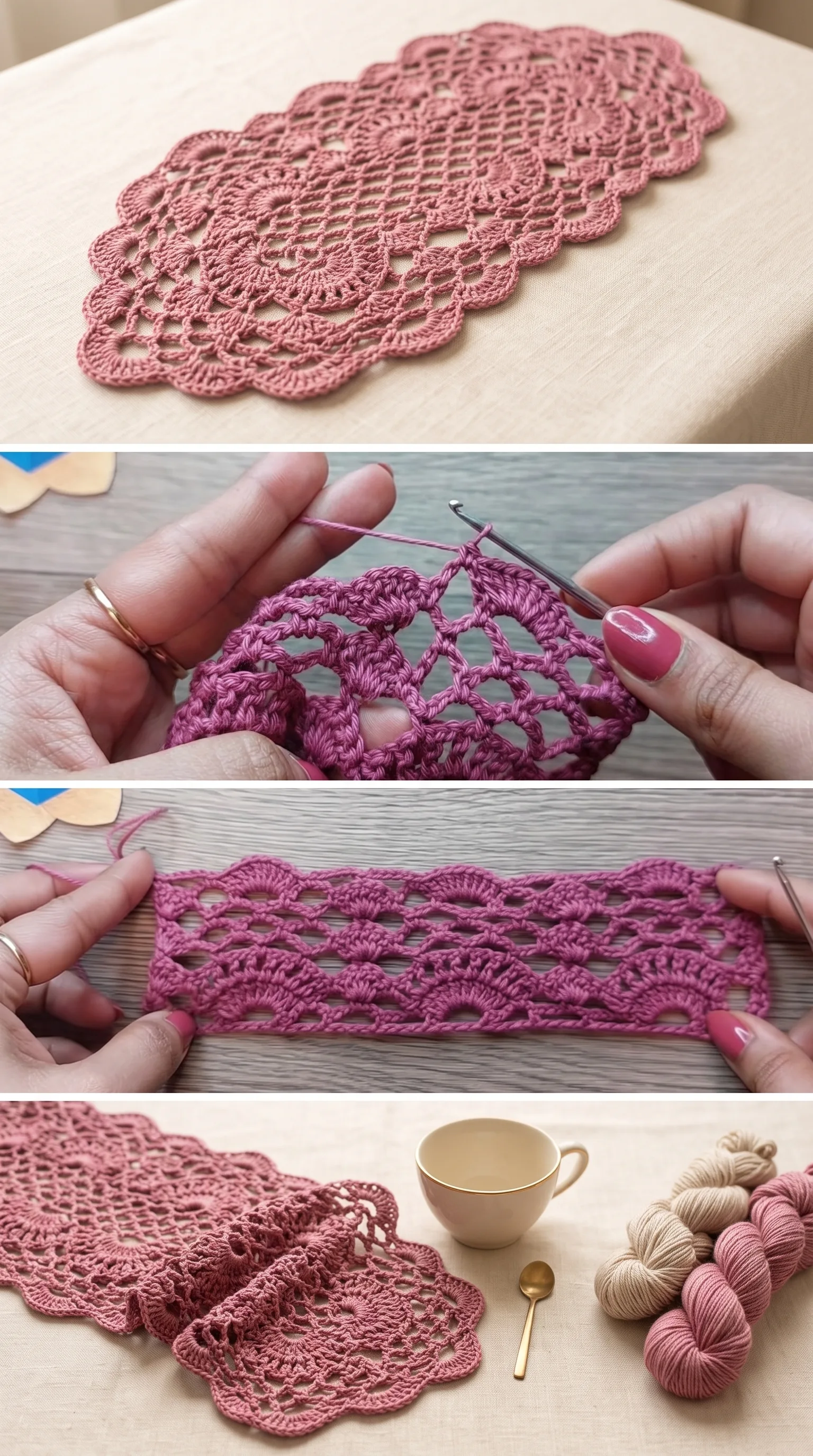
Stitch by Stitch
This pattern draws on a small family of foundational stitches that combine to create something far more intricate-looking than it actually is.
BULLET:CH (Chain) Forms the foundation row and the chain spaces that give the lace its characteristic open mesh between fan clusters.
BULLET:SC (Single Crochet) Anchors the fan motifs at their base points, creating neat structural joints that hold the pattern together row after row.
BULLET:DC (Double Crochet) The primary stitch of each fan cluster, worked in groups into a single chain space to create the scalloped, petal-like shapes.
BULLET:YO (Yarn Over) Used at the beginning of each DC and throughout cluster construction, it is the small motion that gives each stitch its height and the fabric its gentle drape.
Once you find the meditative rhythm of chain, SC anchor, fan cluster, chain, the pattern begins to feel almost automatic, which is exactly the kind of crochet that makes a long afternoon disappear in the most satisfying way.
Construction
The crochet lace runner is worked flat in rows, building width first with a foundation chain and then adding length row by row as the fan pattern repeats horizontally and stacks vertically. As noted in the video tutorial from Crochet World Creations, there is no rigid stitch count requirement, but you do need to ensure your foundation chain produces the same number of pattern repeats on both ends for the scalloped edges to match symmetrically. This makes it wonderfully adaptable: work fewer repeats for a narrow accent runner, or extend the chain generously for a full dining table centerpiece. Beginners will find the repeat settles quickly into memory, and more experienced crocheters can play with adding a decorative SC border along the long edges for a more polished finish.
Wearing Your Lace Runner
This section could equally be titled using your lace runner, because the ways to place it around your home are genuinely varied and all of them are lovely. Lay it along the center of a set dining table with candles and dried flowers placed on top, drape it over the back of a linen sofa for texture, or fold it lengthwise across a vanity table to display small perfume bottles and jewellery. Every time you look at it, you will feel glad you finished it.
Caring for Your Crochet Lace Runner
If you worked your crochet lace runner in cotton or a cotton-linen blend, hand washing in cool water with a gentle soap is always the safest choice to preserve the fiber and the lace structure. Gently squeeze out excess water without wringing, then lay the piece flat on a clean towel and block it to its final dimensions while still damp, pinning each scalloped edge point so the fans dry open and even. Once fully dry, store it folded loosely or rolled around a cardboard tube to prevent permanent crease lines forming across the motifs. Avoid hanging it for long periods, as gravity will slowly stretch the open mesh in ways that blocking alone cannot fully correct.
Every crochet lace runner you finish is a small act of care for the spaces and people around you, and that is worth more than any shop-bought alternative. If you make this one, share a photo on Pinterest and tag it so the wider handmade community can find it and be inspired to pick up their hook.
Follow us on Pinterest and subscribe to the Newsletter so you don’t miss a thing!
Tutorial and photos of this lace runner by: Crochet World Creations.