
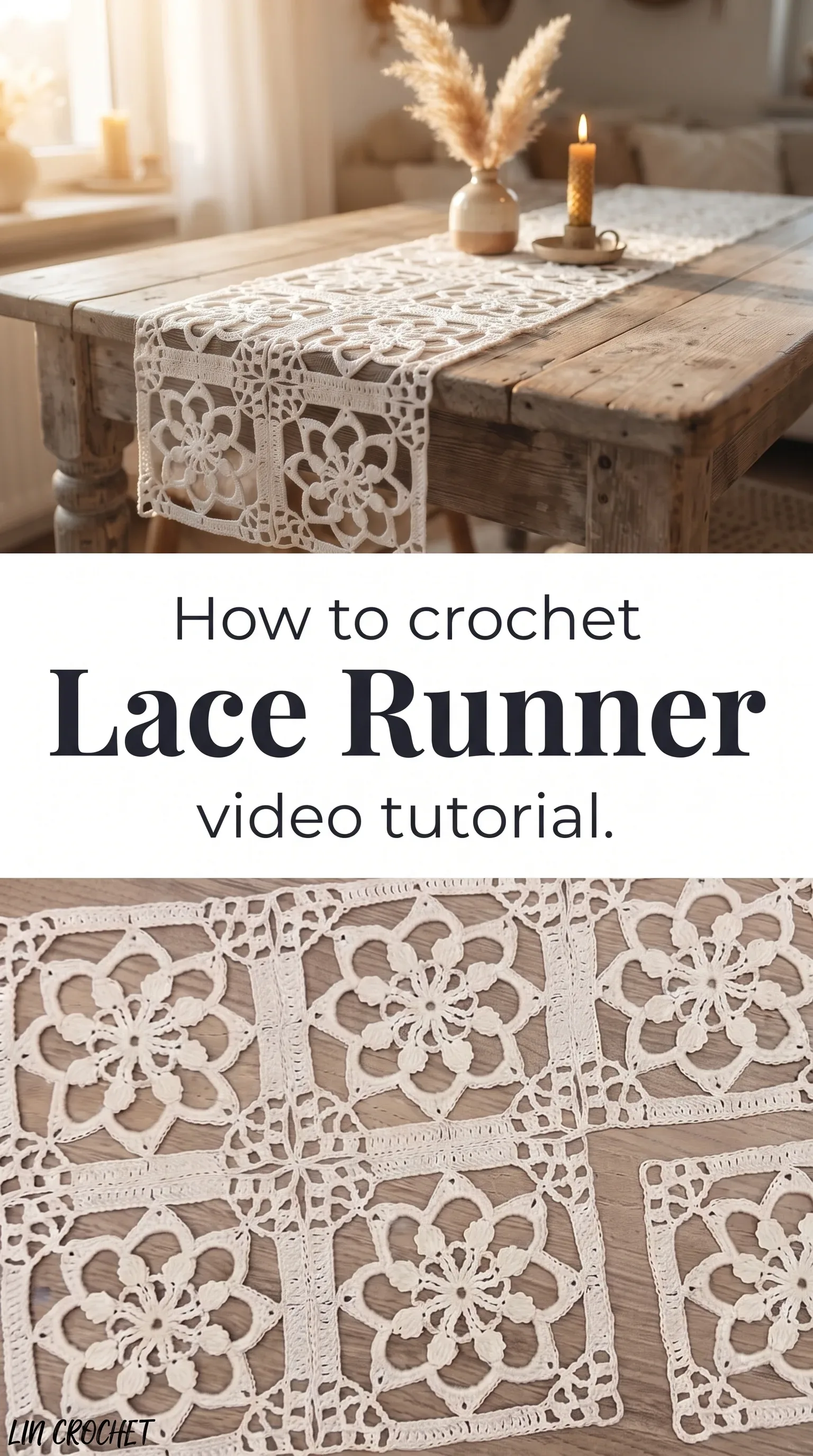
Each square in this Crochet Lace Runner is a four-petaled flower suspended inside a geometric frame, and when joined together, they form a piece that feels like sunlight filtered through old cathedral glass. This single pattern unlocks table runners, placemats, curtain panels, bed scarves, and delicate wall hangings.

The Lace Runner
This Crochet Lace Runner belongs on a long farmhouse table set for Sunday breakfast, draped across a vintage dresser, or layered beneath a cluster of candles and dried flowers. Each motif is airy yet structured, built around a floral center that radiates outward into four rounded petals before settling into a clean square frame with lace-detailed corners. The overall effect is one of whisper-soft formality, something that reads as heirloom without being heavy or fussy. It is the kind of piece that even a relative newcomer to thread crochet can finish and feel genuinely proud of.
Lace Runner Related Posts:
- Crochet Petal Wave Coaster: A Delicate Table Accent
- Crochet Cushion Cover: A Timeless Home Accent
- Crochet Herringbone Stitch: A Timeless Textured Classic
- Crochet Floral Motif: A Delicate Lace Heirloom
Worked in a creamy off-white cotton, this Crochet Lace Runner carries that warm antique quality that makes a table feel curated rather than decorated. But the motif translates beautifully into soft sage, dusty rose, or pale butter yellow for a more cottagecore mood, and into crisp white or natural ecru for something cleaner and more contemporary. You can even use a single accent color for the joining rounds to create a subtle grid effect across the finished piece.
Materials and Tools
This project calls for a fingering weight or sport weight cotton thread, and the difference that fiber quality makes here is significant since mercerized cotton gives the finished Crochet Lace Runner that subtle sheen and crisp definition that makes the flower motifs truly pop. A 2mm to 2.5mm steel crochet hook is ideal for thread-weight work, though if you prefer a slightly more relaxed drape and find steel hooks tiring on your hands, a 3mm hook with a sport weight cotton will give you a beautiful result with a little more body. A tapestry needle with a blunt tip is essential for weaving in ends cleanly between the dense sections of each motif, and a blocking board with rust-proof pins will become your best tool by the time you are assembling your squares. Look for a 100 percent cotton or cotton-linen blend that has a smooth ply so the lacework reads clearly rather than getting lost in texture.
Stitch by Stitch
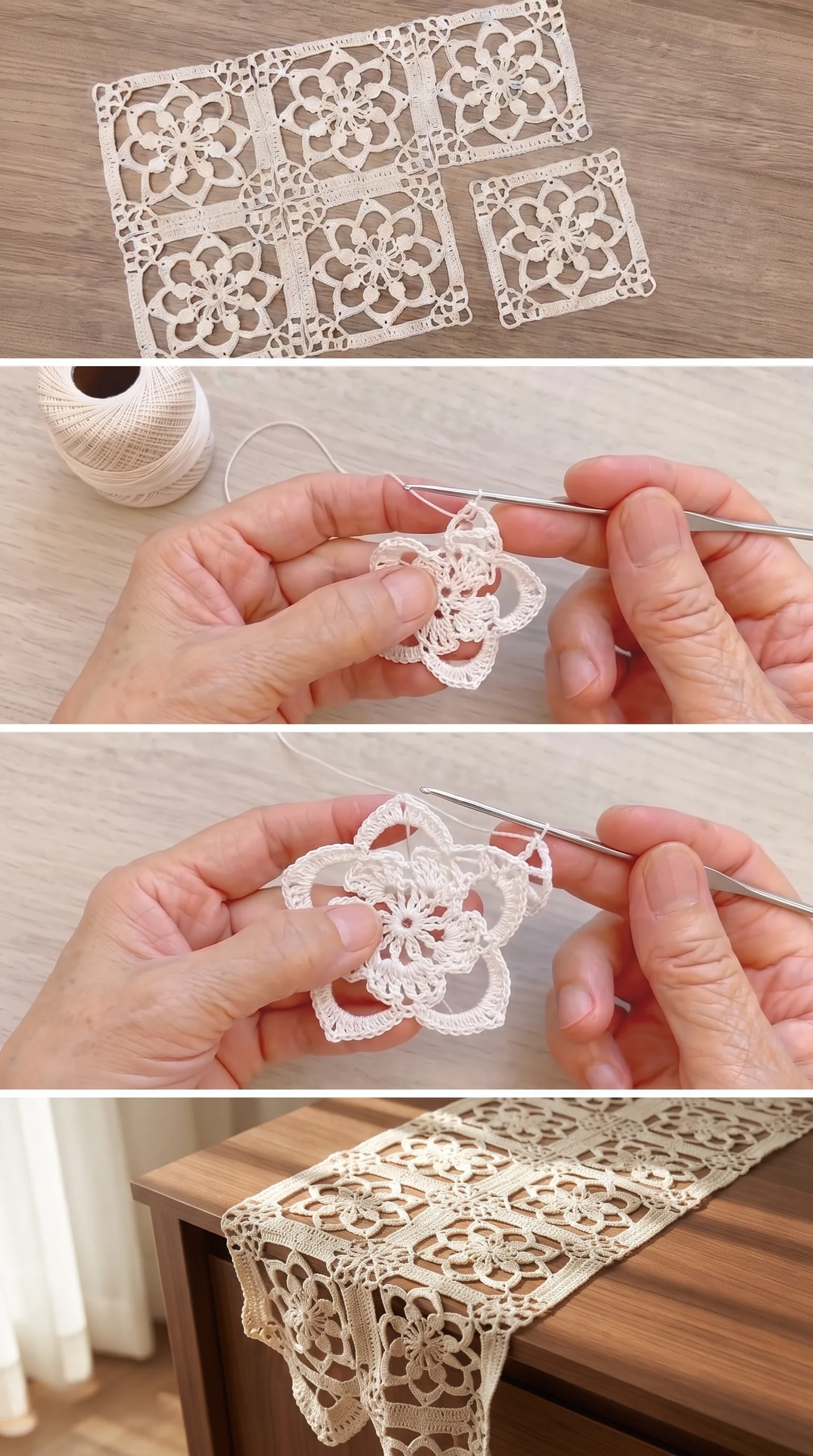
This Crochet Lace Runner draws on a focused set of stitches that layer together to create both the floral motif and the geometric border.
BULLET:SC (Single Crochet) The foundational stitch used to anchor petals and close rounds cleanly at the center of each flower.
BULLET:DC (Double Crochet) The workhorse of this pattern, forming the rounded arches and open mesh sections that give the lace its characteristic breathability.
BULLET:CH (Chain) Used extensively to build the loop structures between petals and along the square border, creating the negative space that defines the lace aesthetic.
BULLET:SS (Slip Stitch) Used to join rounds invisibly and to travel along the work without adding height, keeping the transitions between sections seamless.
Once your hands learn the meditative rhythm of chain, DC cluster, chain, slip stitch, the rounds begin to flow in a way that makes even a long session feel like quiet rest rather than effort.
Construction
Each square motif is worked in the round from the center outward, beginning with a magic ring or a small chain loop that becomes the heart of the flower, then building outward through rounds of petals, connecting arches, and finally the squared border. The full tutorial from Lin Crochet walks through every round of this construction in careful visual detail, so even if you are newer to thread crochet you can follow along confidently without needing to decode a written pattern. Once your individual squares are complete, they are joined using a flat slip-stitch method that creates those elegant raised grid lines you can see running between the motifs in the finished Crochet Lace Runner. To customize the size, simply add more squares to extend the runner lengthwise, or arrange them two across and four or five down for a classic narrow table runner proportion.
Wearing Your Lace Runner
Lay your finished Crochet Lace Runner down the center of a dining table with a linen tablecloth beneath it and let the openwork pattern cast its shadow lace onto the fabric below. Drape it across the back of a sofa or over the foot of a bed for a soft, textural accent that photographs beautifully in natural light. Either way, the moment you place it, the room shifts into something that feels slower and more considered.
Washing and Storing Your Lace Runner
Because this piece is worked in cotton, it can be hand washed gently in cool water with a mild detergent, then pressed lightly in a clean towel to remove excess water before blocking. Blocking is not optional with a Crochet Lace Runner like this one since it is what opens up the chain arches, evens the flower petals, and transforms the piece from a slightly ruffled square into the flat, precise lace you see in the finished images. Pin each square out to its correct dimensions on a foam blocking board and allow it to dry completely before removing the pins. For storage, roll the runner loosely around a piece of acid-free tissue rather than folding it, which prevents crease lines from forming across the lace over time.
Every stitch in this piece is a small, deliberate act of making something beautiful with your own hands, and that is worth far more than any object you could simply purchase. Save this article to your Pinterest boards and share your finished Crochet Lace Runner in the comments so this community can celebrate what you have made.
Follow us on Pinterest and subscribe to the Newsletter so you don’t miss a thing!
Tutorial and photos of this lace runner by: LIN CROCHET.